 |
| |
| 职员手册 (2024年十二月更新) |
| |
|
| |
| 附件 |
| |
| 海鸥反贿赂政策 |
| 1. INTRODUCTION |
Beshom Holdings Berhad (“BESHOM” or the “Company”) and its subsidiaries (the “Group”) are committed
to conducting its businesses in a lawful and ethical manner and maintaining high standards of ethics
and integrity.
Beshom has established this Anti-Bribery Policy (“Policy”) to set out the Company’s expectations for
internal and external parties working with, for and on behalf of the Group in upholding the Group’s zerotolerance
stance against bribery.
This Policy shall form the keystone for the Group’s Anti-Bribery Framework and the relevant policies that
constitute the Anti-Bribery Framework. |
| |
| 2. SCOPE |
This Policy is generally applicable to the Group’s Directors, Employees, suppliers, Distributors, Business
Associates, and any third parties acting on the Group’s behalf, unless otherwise is stated in the specific
policies.
This Policy shall be applicable to all business operations of the Group regardless of country of operation. |
| |
| 3. WHAT IS BRIBERY? |
“Bribery” refers to the act of corruptly giving, agreeing to give, promising, offering, soliciting, receiving, or agreeing to receive any gratification. Gratification can take various forms, including monetary, nonmonetary, services, favours, or any form of benefit or advantage.
[See Section 5: Definitions of this Policy for the legal definition of “gratification”]
A gratification that is given or received with a corrupt intent, including to induce or reward the improper performance of a party, or to obtain or retain business advantage, is considered a bribe.
The Malaysian Anti-Corruption Commission Act 2009 ("MACC Act 2009") prohibits a person or a commercial organisation from giving and receiving bribes, including via agents or associates.
[Refer to Section 16, Section 17, and Section 17A of the MACC Act 2009] |
| |
| 4. OUR ANTI-BRIBERY STANCE |
- The Beshom Group adopts a zero-tolerance approach towards bribery and will not pay bribes to anyone for any purpose.
- The Group takes the upholding of its anti-bribery stance across the Group’s business seriously and expects the same from stakeholders internal and external to the Group’s businesses, extending to all the Group’s business dealings and transactions in all countries in which it operates.
- Directors, Employees, suppliers, Distributors, Business Associates, and any third parties working with, for or on behalf of the Group shall adhere to and observe the Group's anti-bribery stance and relevant provisions, policies, and procedures established by the Group.
- The Group treats any violation of this Policy seriously and will undertake necessary actions, including, but not limited to, review of employment or appointment, disciplinary actions, dismissal, cessation of business relationship, and reporting to the authorities, consistent with the relevant laws and regulations.
- The Group is committed to comply with the relevant anti-bribery laws and regulations, breaches or violation of which may cause great damages to the Group which may include reputational damage, legal fines, or even jail sentences.
|
| |
| 5. DEFINITIONS |
The following definitions and interpretations shall apply in this Policy:- "bribery" refers to the act of corruptly authorising, giving, agreeing to give, promising, offering,
soliciting, receiving, or agreeing to receive any gratification;
- "gratification" shall have the meaning as defined in the Malaysian Anti-Corruption Commission Act 2009, i.e.:
- where this Policy refers to the act of "giving" or "paying" a bribe it also refers to actions amounting to the act of agreeing to give, promising, or offering a bribe;
- money, donation, gift, loan, fee, reward, valuable security, property or interest in property being property of any description whether movable or immovable, financial benefit, or any
other similar advantage;
- any office, dignity, employment, contract of employment or services, and agreement to give employment or render services in any capacity;
- any payment, release, discharge or liquidation of any loan, obligation or other liability, whether in whole or in part;
- any valuable consideration of any kind, any discount, commission, rebate, bonus, deduction or percentage;
- any forbearance to demand any money or money’s worth or valuable thing;
- any other service or favour of any description, including protection from any penalty or disability incurred or apprehended or from any action or proceedings of a disciplinary, civil or criminal nature, whether or not already instituted, and including the exercise or the forbearance from the exercise of any right or any official power or duty; and
- any offer, undertaking or promise, whether conditional or unconditional, of any gratification within the meaning of any of the preceding paragraphs (a) to (f);
- where this Policy refers to the act of "receiving" a bribe it also refers to actions amounting to the act of soliciting or agreeing to receive a bribe;
- "facilitation payments" shall have the definition consistent with that provided by Transparency
International, which is: a small bribe, also called a 'facilitating', 'speed', or 'grease' payment, made
- to secure or expedite the performance of a routine or necessary action to which the payer has
legal or other entitlement;
- "Employees" include full-time, part-time, probationary, contract and temporary employees;
- "Service Providers" include the Group's contractors, sub-contractors, consultants, distributors, agent representative, or any parties performing work or services for or on behalf of the Group;
- "Business Associates" include the Group's joint-venture entities, joint-venture partners, associate companies, and business partners, as well as Service Providers;
- "Officer of a Public Body" shall have the definition as provided in the MACC Act 2009; and
- "Foreign Public Official" shall have the definition as provided in the MACC Act 2009.
|
| |
| 6. BRIBING OF AN OFFICER OF A PUBLIC BODY OR A FOREIGN PUBLIC OFFICIAL |
| The bribing of an Officer of a Public Body or a Foreign Public Official is an offence under the MACC Act 2009 and is likely to be an offence under the local laws in the Group’s countries of operations. Directors, Employees, suppliers, Distributors, and Business Associates of the Group who has dealings with any Officer of a Public Body or Foreign Public Official shall exercise extra care to not engage, directly or through a third party, in any activity or transaction that may constitute, or perceived to constitute, an attempt to bribe an Officer of a Public Body or Foreign Public Official. |
| |
| 7. GIFTS, ENTERTAINMENT AND HOSPITALITY |
While the giving and receiving of gifts, entertainment, and hospitality is not prohibited, they must not be made with the intention to, or perceived to be able to, influence any business-related decisions or outcome.
Gifts, entertainment, or hospitality which may influence, or perceived to be able to influence, any business-related decisions or outcome may be construed as a bribe. Directors, Employees, Suppliers, Distributors, and Business Associates of the Group must avoid giving or receiving gifts, entertainment, or hospitality which may be construed as a bribe.
As a general principle, to avoid situations where there could be actual or perceived conflict of interest, gifts, entertainment, and hospitality shall not be given to any auditor, regulator, government department, agency, authority, or their officers (generally referred to as the "Authorities") or entities directly related to the Authority, if:- the Group is expecting to be audited by, or to apply, obtain, or renew a licence, permit, approval, audit report or any other types of clearance (generally referred to as the "Clearance") from the Authority in the near future; or
- the Group has just applied, obtained, or renewed a Clearance (including the issuance of an audit report) from the Authority in the recent past.
|
| |
| All gifts, entertainment, hospitality provided by the Group or received by the Group's Directors and Employees shall be authorised, processed, and recorded in accordance with the Group's internal policy. |
| |
| 8. THIRD-PARTY TRAVEL |
Third-Party Travel refers to travelling-related expenditures, such as travel, meals, or accommodations, incurred for legitimate business activities, such as an audit or factory visit, which is incurred by a business counterpart and paid for by the Group, or vice versa.
Inappropriate, excessive, or unnecessary Third-Party Travel poses a bribery risk, especially when the business activity in question involves a material interest of a specific party, e.g. an audit, and shall not be provided or received. For the same reason, Third-Party Travel shall not be provided or accepted for persons not relevant for the performance of the work or task in question.
All Third-Party Travel provided by the Group or received by the Group's Directors and Employees shall be authorised, processed, and recorded in accordance with the Group's internal policy. |
| |
| 9. FACILITATION PAYMENTS |
The Group, its Directors, Employees, suppliers, Distributors, and Business Associates are prohibited from, directly or through a third party, giving or receiving facilitation payments. Directors, Employees, suppliers, Distributors, and Business Associates shall comply with the Group's Policy on Facilitation Payments.
Facilitation payments include unofficial and improper payments or benefits, including gifts or entertainment, provided to secure or expedite a routine or necessary action to which the Group is legally entitled. Facilitation payments are bribes and they could be small in value and solicited by both public and private sectors. |
| |
| 10. DONATIONS AND SPONSORSHIPS |
The Group has developed internal policy on donation and sponsorship to establish the guiding policies and procedures for donations and sponsorships made by the Group.
As a general principle, to avoid situations where there could be actual or perceived conflict of interest, the Group shall not make contributions or donations to, or sponsor any events of an Authority, or entities directly related to the Authority if:- the Group is expecting to apply, obtain, or renew a Clearance from the said Authority in the near future; or
- the Group has just applied, obtained, or renewed a Clearance from the said Authority for the Group's business activities in the recent past.
The Group has no political affiliations and it shall not make any political contribution or donations to, or sponsor any events of, political parties, unless approved by the Company’s Board of Directors. Whilst Directors and Employees are not prohibited to make personal political contributions or donations to political parties, the said contributions or donations shall never be associated with the Group and must always be made under the Director and Employee’s personal capacity. |
| |
| 11. BUSINESS INCENTIVES |
Doing business or establishing new business opportunities may involve the use of business incentives, such as commissions, rebates, and referral fees, for promotional and marketing purposes
or for referral to new business relationships or opportunities. That said, certain business incentives may be of questionable nature or may constitute a bribe formulated with the intention to obtain or retain undue business advantage.
The Group shall not provide business incentives which are questionable in nature or are contradictory with anti-bribery laws and regulations.
Business incentives provided by the Group are generally documented and known to all relevant personnel in the Group. |
| |
| 12. BUSINESS DEALINGS WITH SUPPLIERS AND BUSINESS ASSOCIATES
|
The Group, in selecting its suppliers and Business Associates, such as agents, consultants, distributors, or joint venture partners, places great emphasis on integrity and ethical business practices. The Group has established internal procedures which requires due diligence checking to be performed on suppliers and Business Associates before appointment or engagement.
Suppliers and Business Associates are highly encouraged to have in place adequate procedures to prevent the conduct of bribery activity, especially when performing a work or service on behalf of the Group. For business arrangement or business activity which bears a higher bribery risk, as assessed and determined by the Group from time to time, the Group may require the supplier or Business Associate involved to have in place policies and procedures to prevent the conduct of bribery activities. |
| |
| 13. COMPLIANCE AND SUPPORT |
Directors, Employees, suppliers, Distributors, and Business Associates of the Group are expected to refuse to give or receive a bribe when solicited or offered one. The Group is committed to ensuring that no one suffers any detrimental treatment for refusing to give or accept a bribe.
Compliance with this Policy by the Group, its Directors, Employees, suppliers, Distributors, and Business
Associates is mandatory. Any violation of this Policy will be dealt with seriously by the Group and may lead to, but not limited to, review of contracts, employment, or appointment, disciplinary actions, dismissal, cessation of business relationship, and/or reporting to the authorities, consistent with relevant laws and regulations.
Directors, Employees, suppliers, Distributors, or Business Associates of the Group with any concerns or queries or requiring support and advice pertaining to compliance with this Policy shall consult with their respective internal reporting lines or the Group Managing Director, the Group Executive Director cum Chief Financial Officer, or the Anti-Bribery Compliance and Support team.
If there is a suspected violation or potential violation of this Policy, such cases shall be reported via the
Group's whistleblowing mechanism, as outlined in the following section. |
| |
| 14. REPORTING OF VIOLATIONS OF THE POLICY |
Any person, including the general public, who knows of, or suspects, a violation of the Policy is encouraged to report the concerns through the whistleblowing mechanism set out under the Group's
Whistle-Blowing Policy.
No individual will be discriminated against or suffer any sort of retaliation for raising genuine concerns or reporting in good faith on violations or suspected violations of the Policy. All reports will be treated confidentially. |
| |
| 15. REVIEW OF THIS POLICY |
This Policy is approved by the Board of Directors of Hai-O on 28 May 2020.
This Policy shall be reviewed by the Company periodically or at least once in three years. |
| |
| |
| 海鸥举报政策 |
| 1. INTRODUCTION AND OBJECTIVE |
Beshom Holdings Berhad ("BESHOM" or the "Company") and its subsidiaries (the "Group") are committed to conducting its businesses in a lawful and ethical manner and maintaining high standards of ethics and integrity.
This Whistle-Blowing Policy is established to provide employees, stakeholders (e.g. shareholders, customers, distributors, suppliers, and the public) an avenue to raise genuine concerns about wrongdoings, misconduct, illegal acts, or unethical business conduct that is taking place, has taken place, or may take place in the future ("Disclosure"). |
| |
| 2. WHAT CAN BE REPORTED? |
All stakeholders, including employees, distributors, the public, etc., are encouraged to disclose any information or raise a genuine concern about serious wrongdoings, misconduct, illegal acts, or unethical business conduct including but not limited to fraud, corruption, malpractice, financial irregularities, dishonesty, criminal activities, personal misconduct, and serious breach of the Group’s internal policies, procedures, or applicable codes (e.g. Code of Ethics) (generally summarised as the "Wrongdoing").
This Policy does not cover complaints or grievances relating to employment or other business with the Group, which shall be dealt with in accordance with other existing procedures of the Group, unless they involve wrongdoings, misconduct, illegal acts, unethical business conduct.
This whistle-blowing system is not intended to be used for the following:- general complaints about the Group’s products or services;
- matters which are trivial or frivolous or malicious or vexatious in nature or motivated by personal agenda or ill will;
- matters pending or determined through any tribunal or authority or court, arbitration, or other similar proceedings.
Any Disclosure should be based on good faith with a reasonable belief that the information and any allegation in it are substantially true. Any abuse of the whistle-blowing system will be viewed seriously and treated as a gross
misconduct. |
| |
| 3. MAKING A DISCLOSURE |
- A whistle-blower may make the Disclosure either in writing (including email) or orally.
- A whistle-blower shall include the basis or reasons for his/her concerns including as many details as possible in relation to the Disclosure. However, A whistle-blower is not expected to obtain substantial evidence of proof beyond reasonable doubt when making a Disclosure.
- The whistle-blower has the right to remain anonymous when making a Disclosure. However, it is usually easier to conduct a more effective and fair investigation if he/she could identify himself/herself and disclose as much information as possible within his/her knowledge.
- First Contact Point
- If the whistle-blower is an employee of the Group, his/her first contact point shall be his/her direct
superior or line manager. However, for any reason, if it is believed that this is not possible or not appropriate, he/she may report to the Head of Group HR, as follows:
Head of Group HR: Jessica Lim
Office No.: +(603) – 3342 3322 ext. 513
Email: jessicalim@beshom.com
- If the whistle-blower is a distributor of the Group, he/she shall make the Disclosure to the SHOM Compliance Unit, via the following email: COE@shom.com.my.
- If the whistle-blower is neither an employee nor a distributor of the Group, he/she shall make the report to the Head of Group HR.
- Prescribed Persons
If a whistle-blower believes that it will be inappropriate to report to the First Contact Point, the whistleblower
can make the Disclosure to any of the Prescribed Persons, as follows:
| Prescribed Persons |
Group Managing
Director |
Group Executive
Director |
| Name |
Mr. Tan Keng Kang |
Mr. Hew Von Kin |
| Office No. |
+(603) - 3342 3322,
Ext:518 |
+(603) -3342 3322,
Ext:515 |
| Email |
GrpDir@beshom.com |
For any Disclosures made via email to the Prescribed Persons, the email shall be addressed to the dedicated whistle-blowing email provided above, which is accessible by all Prescribed Persons.
For any Disclosures made via phone calls, orally, or in writing, the Prescribed Persons are generally required to inform each other of the Disclosure.
If the Disclosure issue involves any of the Prescribed Persons or any Directors, it shall be made to the Independent Directors of the Group, in accordance with Item 3(f) below.
- In the case where making a Disclosure to management is a concern, then the report may be made directly to the Chairman or the Audit Committee Chairman, who is an Independent Director of Beshom, as follows:
| |
Chairman, Senior Independent Director |
Audit Committee Chairman |
| Name |
Mr. Ng Chek Yong |
Dato' Lee Teck Hua |
| Email |
ngcy@beshom.com |
leeth@beshom.com |
- Any persons who receives a verbal Disclosure in accordance with Paragraph 3(d), (e), or (f) above shall put in writing the Disclosure and its details which is to be confirmed by the whistle-blower.
|
| |
| 4. ACTIONS IN RELATION TO THE DISCLOSURE |
- In addressing any Disclosures, depending on the seriousness of the alleged Wrongdoing, the relevant authorities within the Group shall decide on how the Disclosure shall be handled, including investigation, enquiries, and deliberations on the outcome.
- All alleged Wrongdoings involving fraud or bribery shall be notified to the Audit Committee, who shall
have the authority to designate any person, within the Group or external to the Group, to oversee and conduct relevant investigation.
- All alleged Wrongdoings involving a Director or a Prescribed Persons shall be escalated to the Audit Committee, who shall handle the Disclosure, including investigation, enquiries, and deliberations on the outcome.
- In general, an independent party, which may be the internal audit, an external independent auditor or professional, or an Independent Director, shall always be involved in an investigation process.
- Any person, including Directors if any, who are related to or involved in the alleged wrongdoing concerning the Disclosure shall be excluded from the investigation, recommendation, and deliberation procedures to ensure the objectivity and independence of the Disclosure handling process.
- All Disclosures received and handled by the First Contact Point and Prescribed Persons are required to be summarised in a report to the Executive Risk Committee, at least once in a year.
|
| |
| 5. BEING INFORMED AND HAVING THE OPPORTUNITY TO BE HEARD |
- A whistle-blower shall be informed of the status of his/her Disclosure, including the outcome of the deliberation, as far as reasonably practicable, in writing.
- The alleged wrongdoer, which may include the whistle-blower in the event the whistle-blower is implicated or discovered to be involved in the allegation, may be asked to attend a meeting to discuss the allegations and he/she shall take all reasonable steps to attend the meeting. He/she shall be given an opportunity to answer the allegations at the meeting which shall be minuted.
- If an investigation is conducted on a whistle-blower who is implicated or discovered to be involved in the allegation, it shall not be treated as a reprisal against the whistle-blower but a facilitation of factfinding and decision making.
|
| |
| 6. WHISTLE-BLOWER'S PROTECTION |
- Every effort will be made to protect and keep confidential a whistle-blower's identity, subject to relevant legal constraints.
- A whistle-blower shall be protected from reprisal within the Group as a direct consequence of a Disclosure made in good faith. A reprisal refers to any disciplinary actions, which may include a warning or letter or reprimand, demotion, loss of merit, loss of bonus, suspension without pay, or termination of employment. Any such reprisal against the whistle-blower shall be consider a serious breach of this Policy.
- If a whistle-blower reasonably believes he/she is being subjected to harassment, victimisation, reprisal as a direct consequent of having made a disclosure under this Policy, he/she may reach out to higher authority as provided in Paragraph 3(e) or (f) above. Essentially, the complaint shall be processed in a similar manner as a whistle-blowing Disclosure.
|
| |
| 7. REVIEW OF THIS POLICY |
This Policy is approved by the Board of Directors of Hai-O on 28 May 2020.
This Policy shall be reviewed by the Company periodically or at least once in three years. |
| |
| 道德与商业行为准则 |
| |
| 1. INTRODUCTION |
Beshom Holdings Berhad and its subsidiaries (the "Company" or "Group") is committed to conducting its businesses in a lawful and ethical manner and to driving and upholding Beshom Group’s corporate values. Similarly, Beshom Group also expects the same level of integrity, honesty, openness, and transparency being upheld by the Group's Directors, Employees, Distributors, Suppliers and Business Associates when dealing business with Beshom Group.
This Code of Ethics and Business Conduct explains the standard of behaviour that Beshom expects in your daily work. The Code cannot foresee every situation that might arise in a complex business world. Rather, it identifies guiding principles to help you make decisions consistent with Beshom's values and reputation. You should also familiarize yourself with various corporate policies that provide more detailed guidance on specific issues that may affect your work. From time to time, changes in the business context or regulatory environment will create a need for new guidelines. As a result, the Code is subject to change as and when necessary.
This Code is written in English and Chinese editions. However, the English version prevails whenever
there are differences in context among the 2 versions. |
| |
| 2. WHO MUST FOLLOW THE CODE |
| This Code is applicable at all times, without exception, to all members of The Board of Directors and all Beshom employees, business associates as well as third parties (such as agents, consultants) if duly authorized by Beshom when dealing or acting on behalf of Beshom are also expected to adhere to the Code. |
| |
| 3. COMMITING TO THE CODE |
| Newly-hired employee must sign an acknowledgement that they have read and understood the Code upon commencement of his employment. All members are also required to acknowledge if there are
any changes to the Code or on cases where applicable. A soft copy of the Code will be updated and posted on the intranet for viewing by any employees and directors. |
| |
| 4. POLICIES AND PROCEDURES OF THE CORPORATION |
| Each business group, division or department issues its own set of policies and procedures, in line with Beshom's corporate policies. Employees have an obligation to follow those policies and procedures in addition to those described in this Code. |
| |
| 5. THE RESPONSIBILITY OF EMPLOYEES |
As a member of the company, you are expected to:- Act honestly, diligently and in good faith when discharging and performing duties and
responsibilities;
- Act honestly, diligently and in good faith when discharging and performing duties and responsibilities;
- assist company to promote and maintain a good, safe and healthy working environment;
- Contribute towards achieving the Company's objectives to the best of your abilities, while making decisions consistent with the Code;
- consult your superior or HR department manager if you have any questions about the Code.
If you are aware of a possible breach or violation of the Code, you are expected to:- act promptly and in good faith by raising it with your superior and such breach or violation remain confidential before a full investigation is conducted. The authorized personnel will investigate the matter promptly;
- take your concern beyond your superior to Managing Director or Executive Directors if the suspected breach you have reported was not resolved;
- report directly to Group Chairman if the possible breach involves any member of the Board and
keep Audit Committee informed;
- be prepared to cooperate in the investigations regarding violation of the Code.
|
| |
| 6. WHISTLE-BLOWING POLICY |
The whistle-blowing policy is to provide employees an avenue to raise concerns without fear of reprisal and to promote the highest possible standards of ethical and legal business conduct. The objective of having the policy is also to deter serious malpractice and to avoid crisis management, thereby promoting the best practice of corporate governance at workplace.
As an employee, you are encouraged to disclose any information or raise a genuine concern about serious breaches of Code. Any concerns about malpractice should always be raised internally in the first instance. Such breaches of code or violation of law include but not limited to fraud, corruption, malpractice, financial irregularities, dishonesty, criminal activities and personal misconduct.- his/her immediate supervisors/ managers or higher authorities along his/her reporting line; or
- the Head of Group HR, the Group Executive Director cum Chief Financial Officer, or the Group Managing Director if the supervisors/ managers mentioned above are not applicable or contactable.
If a supervisor/ manager or higher authorities within the Group is contacted for advice and was unable to assess or determine the correct action for the situation, he/she shall further seek advice from his/her superior, as so on, or from the Group Executive Director cum Chief Financial Officer or the Group Managing Director.
Whistle-blowing is not for use to raise grievances concerning personal employment or as appeals against decisions of management unless they involve fraud. Such private grievance related to personal employment matters should be directly reported to Group HR Department. Any abuse of the whistleblowing system through raising unfounded allegations shall be subject to a disciplinary offence.
If you report a possible breach of the Code, you have the right to remain anonymous and confidentiality will be maintained. Every effort will be made to protect the whistle-blower or complainant's identity, subject to relevant legal constraints. However, it is usually easier to conduct a full and fair investigation of your concerns if you could identify yourself and disclose as much information as possible within your knowledge. |
| |
| 7. THE RESPONSIBILITY OF MANAGEMENT |
The responsibilities of Beshom managers and directors include and go beyond those of other employees. You are expected to:
- lead by providing a model of high standards of ethical conduct, creating a positive work environment reflecting the content and the spirit of the Code;
- be vigilant in preventing, detecting and responding to any violations of the Code;
- protect those who report violations.
|
| |
| 8. CONFLICT OF INTEREST |
All members of the company shall act in the best interests of the Company whilst carrying out his or her responsibilities. Employees should not be involved or engaged in anyway with any activities which materially interferes with the proper performance of his or her duties or obligations to the Company, whether such activities are related to the Company's business or not.
The Company's code of ethics requires that all employees to avoid any conflict between their own interests and the interest of the Company. A conflict of interest will arise where an employee's ability to
perform his or her Company duties may be adversely affected by an outside appointment, relationship or activity. Employees shall not have personal or family financial interest or own shares in other
companies which compete with the Company's business with the exception of the publicly traded companies or with the prior written consent of the Company.
Employee should not take improper advantage of their position as employees of the Company or of any information obtained in the course of their employment to secure personal advantage. Any action or omission by any employee for the purpose of gaining personal advantage (including for the benefit of his family or friends) as a result of knowing that the Company is contemplating or has decided upon a course of action is totally prohibited. |
| |
| 9. GIFTS & ENTERTAINMENT |
| The giving and receiving of gifts, entertainment, and hospitality could be a common business
practice in managing business relationships, especially in certain countries or cultural background. |
| |
| 9.1 Receiving Gifts & Entertainment |
An employee or his relatives should not accept cash, commission, expensive gifts, extravagant entertainment or benefits-in-kind of free or at very low costs from any company or individual doing
or seeking to do business with the Company. Such personal favour might induce the employee to favour the third parties and affect the judgement as to what is the best for the company and could
be considered as a bribe.
Sometimes it is a business custom and practice to receive gifts and entertainments. To avoid conflict of interest, you should follow the guidelines set as below:- All gifts and entertainment given or received shall be in accordance with the Group's Policy on Gift, Entertainment, and Hospitality.
- You may accept gifts that are appropriate to the business relationship.
- When you receive gifts, you should report to your superior or may be required to handover the gifts to the Group Admin Department for company use or as a lucky draw gifts for staff
whichever purpose that may deem fit. And such receipt shall be properly recorded by Group Admin Department.
- Customary business entertainment such as lunch, dinner, or sporting events, is appropriate if
it is made known to the superior and of a reasonable nature, and its purpose is conducting business discussions or fostering better business rapport.
In cases where employee nominated by Company to attend the event or convention (with lucky draw) organised by external party such as suppliers, business partners or trade / non-trade associations, the employee shall notify the Group HR Department if they entitled to lucky draw and won the prize. Employee may take ownership on the wining prize if the value is RM1,000 and below. Employee must surrender the winning prize to Company if the prize is valued above RM1,000. The
Company reserves the absolute rights to change the policy or prize limit as and when deemed fit / necessary. |
| |
| 9.2 Giving of Gifts & Entertainment |
Entertainment expenditures may be incurred in the business. It is applicable to Sales Manager, Company Heads, or Senior Officers. Any entertainment expenses that are non-sales related should
be pre-approved by Group Executive Director or Group Managing Director. The employee concerned shall refer to the Gift, Entertainment and Hospitality Policy issued by the Group for more
details.
Expenses incurred for such business entertainment must be supported by receipts stating those entertainment and purpose (for those without bill, explanations must be given in writing and must
sought superior's signature). Claims, which are found to be excessive or unjustifiable will not be reimbursed and the employee concerned will have to bear the cost.
A claim shall be made, appropriately with bills, through Expenses Reimbursement Form (HAIO/GP/FORM5) devised for the purpose. The Expenses Reimbursement Form shall first be submitted to the assigned superior/ higher authority, who shall subsequently verify and approve the claims. |
| |
| 10. CONFIDENTIAL INFORMATION |
Employees are to maintain strict confidentiality of all data or information concerning the Company, or any of its associates/related companies. The data or information such as corporate proposals /exercises, costing, salary, trade secrets, processes, methods, decisions, advertising or promotional programs, distributor network structure and bonuses, customer and supplier list, business forecasts and discoveries and financial reports which have not been officially announced or are all regarded as confidential in nature. Under no circumstances should the employee divulge to any person or firm the
secrets of the Company, and especially not to reveal our supplier's and customers' details to any third party, unless requested by any financial institutions, government bodies and properly authorized by the
Group MD/ED and Group CFO. This provision shall be applicable even after the termination of employment with the Company.
Employees should also exercise caution to avoid misusing or unintentionally disclosing confidential information, this includes:- Keeping electronic and paper documents and files containing confidential information in a safe place;
- Not discussing confidential matters where they could be overheard, for example, in public places such as elevators, hallways, restaurants, etc.
- Transmitting confidential documents by fax or e-mail, only when it is reasonable to believe this can be done under secure conditions;
- Restrict from using confidential documents as recycled papers; and
- Shredding off documents instead of disposing in dustbin once the documents need to be discarded.
Directors and key personnel who have access to such data and information are required to sign off a Confidentiality Statement with terms that will take effect after the cease of employment or directorship.
Non-Disclosure Agreements (NDA) shall be extended to consultants, vendors or contractors or any external party to protect and restrict the use of business information if it is required to disclose to the other party for a potential business undertaking. The NDA shall be signed off between the parties before or upon commencement of the potential business transactions.
Dealing in Listed Securities (Beshom listed shares)
The directors, principal officers (as defined under 14.02 (i) of the Bursa Main Market Listing
Requirements (MMLR) are required to comply with the Bursa requirements, in relation to dealing Beshom listed shares.
An affected person must not deal in the listed securities of the company as long as he is in possession of price-sensitive information relating to the company. However, who is not in possession of pricesensitive information relating to listed securities may engage in dealings with such listed securities during a closed period provided that he / she complies with the procedures set out in paragraph 14.08 of the MMLR.
"Closed Period" means a period commencing 30 calendar days before the targeted date of announcement up to the date of the announcement of its quarterly results to the Exchange.
The company may extend the obligation to observe the requirements on dealing of Beshom listed shares to employees who though not the principal officers as defined under the MMLR but may have access to the price sensitive information in any form of sources. The named employees (the name list is at the
discretion of the Company and who will be officially notified by HR Dept) are free to trade during open period and are required to practice the procedure notifying his/her intention to trade and inform the company (Group Finance Department) via a prescribed form (Notification On Dealing Of Shares During Closed Period) the details of shares purchased/sold during closed period within 3 market days immediately after the transactions, if any. |
| |
| 11. PUBLIC ANNOUNCEMENT |
| Employees are not allowed to make public statements regarding the affairs and corporate news of the Company unless it is authorized by the Board of Directors of the Company. |
| |
| 12. RELATED PARTY TRANSACTION |
Neither the employee nor his/family shall, whether directly or indirectly, enter into any contractual arrangement or business transaction with the Company (other than employment contracts and normal staff purchase) or any of its current or prospective suppliers or customers for the purchase, sale, lease or supply of products services or others that may create a conflict of interest.
If a related party transaction (RPT) is unavoidable and base on the ground of fair competition, the employee is required to fill in a declaration form and to submit to the Group Internal Audit Department
and to be approved by the Group RPT Committee. In the event the transaction involves a company director, Group Internal Audit Department shall submit the declaration form as received or compiled to
Audit Committee for review and approval.
If the transaction if of material value, there is equals or above 5% of the Group Net Tangible Asset value, the related party transaction (whether involves employee or director or person connected to them) should get the prior approval from the Board of Directors and from the shareholders (if the case need so) subject to the Bursa Securities Listing Requirements.
The Company will also report all material related party transactions as required by Bursa Securities or any other regulatory bodies. |
| |
| 13. INSIDER TRADING |
| Non-public information which might influence the market price of the Beshom shares shall be kept in strict confidence until publicly released by the Board of Directors or Managing Director who is authorized by the Board of Directors. Furthermore, employees who have sensitive information which could influence the price of Beshom shares and related rights, must refrain from directly or indirectly executing transactions in Beshom shares and related rights and revealing such information to others. |
| |
| 14. COMPLIANCE OF GOVERMENT RULES |
| Notwithstanding anything to the contrary, an employee shall not do or omit to do any act which would result in the contravention of any law in Malaysia and other rules, regulations and by laws of the States which might be applicable. The company and its employees and partners should also be aware of complying with the legal and contractual obligations in dealing with the foreign governments and
regulatory agencies with which they are in contact. |
| |
| 15. COMPANY PROPERTY & INTELLECTUAL PROPERTY |
| Company property should only be used for legitimate business purpose. Employees are expected to take good care of company property and not expose it to loss, damage, misuse or theft. Company chop and any pre-printed documents bearing the Company's logo must be kept in a safe place. Similarly, employees have a duty to protect Company's intellectual property such as trademarks, domain names,
patents, industrial designs, copyrights and trade secrets. Any inventions, discoveries, IT programmes, design or ideas by employees during the course of their work shall be deemed fully & completely by the
Company’s property. |
| |
| 16. PURCHASING CODE OF ETHICS |
The purchasing code is a code that applies to all employees involved in the purchasing process within the Company. The purchasing employees are expected to:- To give first consideration to the objectives and purchasing policies of the Company;
- To strive to obtain the maximum value for each ringgit of expenditure;
- To support the principle of fair competition as a basis for selecting suppliers and awarding business to suppliers (minimum two quotations must be sought for making fair comparison);
- To fully comply with the internal purchasing process of purchase requests and purchase orders when awarding business to a supplier. No purchase will be done without a properly authorized Purchasing Order;
- To authorize Purchasing Order within the approved purchase limit;
- To make every reasonable effort to negotiate an equitable and mutually agreeable settlement of any controversy with a supplier.
The above-mentioned policies are part of the purchasing policies and standard practices, purchasing employees are obliged to refer and comply with the full and detailed set of the purchasing policies apart from the Code. |
| |
| 17. FINANCIAL CODE OF ETHICS |
As a public listed company, it is of critical importance that corporate filings and disclosure of material information to Securities Commission, Bursa Malaysia and other relevant government bodies be accurate, clear, timely and complete. The Finance & Accounts Departments bear a special responsibility to the Company. Because of this special role, all members of Finance & Accounts Departments are
bound by following Financial Code of Ethics:- Act honestly, professionally and in good faith when discharging and performing duties and responsibilities;
- Ensure due diligence is observed when disseminating financial or relevant information that is accurate, complete, timely and understandable in reports and documents that Beshom files with, or submits to, government agencies, securities commission, Bursa Securities and in other public communication;
- Refrain from directly or indirectly taking any action to fraudulently influence, coerce, manipulate or mislead persons preparing the financial statements or to otherwise take any action directly or indirectly that would cause such financial statements to be materially incorrect or misleading;
- Ensure that the company's accounts and reporting complied with applicable approved accounting standard in the country it operates;
- Give due consideration to assessing the quality of financial controls, including internal controls over
Financial reporting, as well as to implementing control improvements;
- Ensure that the professional competences and skills are maintained at a level that is consistent with the responsibility of their job, with due observance of requirements from professional bodies.
|
| |
| 18. ANTI-BRIBERY AND ANTI-CORRUPTION |
This Code makes reference Beshom Group’s Anti-Bribery Policy and collectively promote good and sustainable business practices (extract of this policy is available on Beshom's corporate website at www.beshom.com).
The Company and its group of companies have adopted a zero-tolerance approach to bribery and will not pay any bribes to anyone for any purpose. All employees are prohibited from soliciting, accepting, offering, or giving any form of bribes in the conduct of the Company’s businesses. All employees shall refer to, understand, and comply with the Group’s Anti-Bribery Policy, including the specific policies referred therein.
When faced with any attempted bribery or bribery conduct, an employee who is offered a bribe or being
solicited for a bribe must refuse the offer or solicitation and report to any member of the Anti-Bribery Compliance and Support team (ABCS).
Any employee who is involved in a bribery conduct, whether as a giving or receiving party, will be dealt with seriously by the Company, including any appropriate disciplinary actions, as well as reporting to the relevant authorities. |
| |
| 19. HEALTH & SAFETY AND ENVIRONMENT |
All employees shall take reasonable measures to minimise the impact of business operation through strengthened efforts towards protecting the environment.
The Company Safety Policy is committed to a strong safety program that protects its staff, its property and the public from accidents.- Our objective is to conduct our business in the safest possible manner consistent with the Occupational Safety & Health Act, and any other applicable legislation.
- Employees at every level, including management are responsible and accountable for the Company's overall safety initiatives.
- Complete and active participation by everyone, everyday in every job is necessary for the safety among all workers on the job site.
- An injury and accident-free workplace is our goal.
Creating a healthy and accident-free workplace is our commitment. We believe that all accidents can be prevented and that all employees have a common responsibility to care each other and environment. The full co-operation and support from all employees are necessary to ensure the Safety Policy and initiatives are implemented effectively. |
| |
BESHOM HOLDINGS BERHAD AND GROUP OF SUBSIDIARIES
("BESHOM GROUP" OR THE "GROUP")
INTEGRITY AND BACKGROUND DECLARATION FORM
FOR EMPLOYEES |
| |
Name of Person ("I"):
Position:- I have read and fully understood the contents of Beshom Group’s Code of Ethics & Business Conduct, including the Group's Anti-Bribery Policy and specific policies referred therein.
- I shall at all times comply with Code of Ethics & Business Conduct laid down being essential for the proper conduct of my employment with the Group.
- I shall continue to abide on the code of confidentiality (item 10) of the Code of Ethics & Business Conduct after termination of my employment with the Group.
- I declare that, to the best of my knowledge: (tick whichever is applicable)
( ) I am not aware of any conflicts that I have with the Group, its personnel, or its business.
( ) apart from the conflicts declared below, I am not aware of any other conflicts that I have with the Group, its
personnel, or its business.
| |
Name of Conflicted
Party
(actual, potential, and
perceived) |
Relationship
with Conflicted
Party |
Nature of Conflict of Interest Situation with the
Beshom Group and Detailed Description
(e.g. shareholdings, directorships, or close family
member relationship) |
( i ) |
|
|
|
( ii ) |
|
|
|
( iii ) |
|
|
|
( iv ) |
|
|
|
I agree to notify the Beshom Group, as soon as practicable, on any emerging or new actual, potential, or
perceived conflict of interest situations arising.
- I declare that: (tick whichever is applicable)
( ) I have never been convicted of any crimes or offences, other than traffic offenses (if any).
( ) I have been convicted of the following crimes or offences, other than traffic offenses (if any).
- Failing to comply with the Clauses 2, 3, and 4 above, the Group has the right to undertake any disciplinary action against me for serious misconduct including suspension or dismissal or even legal actions.
Note:
You are required to disclose any conflict of interest situations with the Group, which may include, but not limited to, the following (i.e. Close Relationship - family members or related party as defined under Chapter 1 of Bursa Malaysia Securities Berhad’s Main
Market Listing Requirements):- a director or employee of the Group having a Close Relationship with an external stakeholder of the Group, such as a supplier, distributor, customer, or a person with authority at a regulator, government agency, department, or authority which the Group is required to deal with substantially, etc.;
- a director or employee of the Group having a Close Relationship with another director or employee of the Group;
- a director or employee of the Group having a Close Relationship with a recipient of donation or sponsorship made by the Group; and
- a director or employee of the Group having a Close Relationship with a key competitor of the Group
(Note: Close Relationship – "family members" or "related party" as defined under Chapter 1 of Bursa Malaysia Securities Berhad’s Main Market Listing Requirements)
I declare that all information provided in this Form is, to the best of my knowledge and belief, true, complete, and
accurate. I understand that if any information is untrue, incomplete, or inaccurate, the Beshom Group reserves the right to review my employment with the Group including but not limited to contracts, employment or appointment, which may lead to disciplinary actions, dismissal, and even reporting to the authorities. |
| |
| Name |
: |
----------------------------------------- |
| NRIC No./ Passport Number |
: |
----------------------------------------- |
| Signature |
: |
----------------------------------------- |
| Date |
: |
----------------------------------------- |
|
| |
| APPENDIX I: CONTACT DETAILS FOR BREACH OF CONDUCT |
| |
| First Contact Point |
Jessica Lim
(Head of Group HR) |
12, Jalan Selasih Off Jalan Teluk Gadong, 41100 Klang Selangor
Email: jessicalim@beshom.com
|
| Prescribed Persons |
Tan Keng Kang
(Group Managing Director) |
1, Jalan Kelawar, 6/4H, 40000 Shah Alam, Selangor
Office No: 03-3342 3322 Ext: 518
Email: tankk@beshom.com |
Hew Von Kin
(Group Executive Director) |
11, Jalan SS1/2, Kampung Tunku, 47300 Petaling Jaya, Selangor
Office No: 03-3342 3322 Ext: 515
Email: hewvk@beshom.com |
| Chairman |
Ng Chek Yong
(Group Chairman, Senior Independent Director) |
No. 1D6, Block D, Lorong F, Village Grove Condominiums, Taman Satria Jaya, BDC Stampin, 93350, Kuching, Sarawak
Email: ngcy@beshom.com
|
| Audit Committee Chairman |
Dato' Lee Teck Hua
(Independent Director of Beshom) |
No. 15A, Jalan Batu Tiga Lama, Kawasan 16, Taman Rashna, 41300, Klang, Selangor.
Email: leeth@beshom.com |
|
| |
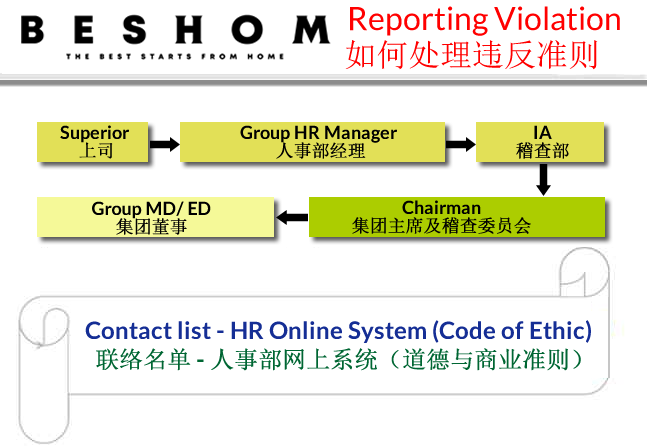
| APPENDIX II: REPORTING VIOLATION |
|
| |
| 保密政策 |
| 1. 目标和目的 |
海鸥控股及其子公司和联营公司( “海鸥集团”或“集团”或“公司”)的所有董事、雇员和其他人员有义务在他们受雇或任职期间所收到的信息保密。此保密政策规定了海鸥集团董事、雇员和其他人员的保密责任和义务。
海鸥集团的董事、雇员和其他人员须清楚知道在其任职期间将会了解并拥有或掌握集团或第三方向集团披露不为普遍所知的信息。可能包括的信息如泄露了可能会损害海鸥集团利益,也包含可能损害“集团”利益的商业机密信息的揭露。
海鸥集团所有董事、雇员和其他人员有责任和义务对集团相关的信息严格遵守保密,并将其依法用于正当的目的上。 |
| 2. 宗旨 |
保密政策的宗旨是制定必须遵守的保密原则。 本政策适用于所有与海鸥集团合作并有机会接触到海鸥集团机密信息的人员。
此政策(如相关)同时应用于海鸥集团签发予董事,雇员和其他人员的委任书和/ 或雇佣合约,以及其涉及任何与 工作相关的条规,政策和程序。
|
| 3. 机密信息 |
机密信息是指任何还未公开让大众知晓的信息。它涉及公司技术、业务、财务、交易或其他事务。它也包括了具商业价值较高的信息,如:集团战略提案、业务计划、商业秘密、与供应商和客户之间的贸易条款以及产品成本和利润率等商业信息,以及个人信息。
机密信息的例子包括但不限于:任何文件、创造、发明、改进、专利说明书、生产程序、设计、专有技术,营销和销售数据,配方,计划,想法,书籍,账户,数据,报告,各种文件的草稿,通信,客户信息,名单和档案, 决策, 产品信息, 进出口信息, 员工相关的信息, 战略, 绘图, 建议, 办公室前例,政策和程序 ,预测 , 预算和财务信息,包括任何呈现形式,如:海鸥集团以书面,口头或电子形式准备的任何文件或信息,可根据该信息的性质或当时披露的情况合理的视为机密信息,无论其是否在披露时被确定为“受限制资讯” 。
对于还未发布/刊登的发明或设计是属于特别敏感的信息。例如,在提交专利申请之前披露未公开的发明信息或设计信息将导致该发明或设计持有者的知识产权受到不可逆转的损失。即使在提交专利申请后,也必须留意不可公开披露对发明或设计改进的相关信息,这将导致商业秘密丧失该有的保护。
|
| 4. 原则 |
海鸥集团期望所有董事、雇员和其他人员都能以敏感和专业的处理方式处理所有机密信息。集团董事、雇员和其他人员有义务不获取或试图获取其未经授权的信息。然而,集团也清楚知道具有明确沟通和问责制的透明度文化的重要性。因此,海鸥集团希望能维护个人和集团数据的安全,并期待所有董事、雇员和其他有关人员务必以保护集团数据安全的方式处理集团的任何机密信息。
保密的目的基本上有两个层面:(一)保护集团及其利益相关者、供应商、业务伙伴、客户和顾客们的敏感或机密信息。(二)基于集团的有效运作为考量,集团董事、雇员和其他有关人员在工作过程中有必要共享某些信息和知识,此保密政策是建立彼此信任的必要条件。
防止泄露机密信息的最佳保护措施是将有权收悉敏感信息的雇员和人员的数量保持在基本的最低人数。
任何雇员故意、重复、意外或未经授权披露任何机密信息将受到纪律处分。 任何纪律行动将会考虑信息的性质如其机密性和敏感度,并妥当的处理泄露信息事件,确保违反保密政策的情况不再发生。
|
| 5. 维护保密和不披露原则 |
海鸥集团的董事、雇员和其他人员:
- 必须对所有机密信息保密;
- 仅限于担任海鸥集团董事和雇员在履行其职责时使用的机密信息;和
- 只能向已经知道机密信息且已知须要保密的人员和那些须要被告知机密信息的人员披露有关的机密信息(仅限于每个人都需要知道情况下)。
董事、雇员和其他人员对保密和不披露原则的义务将不包括依据法院或任何政府机构命令下所要求而必须披露的机密信息。若有以上情况,该雇员或人员须及时通知公司有关要求,以便公司根据具体情况回应并采取适当的行动。
在雇佣期结束时,海鸥集团董事、雇员和其他人员必须将以下信息/物品退还给集团:
- 所有物质形式的机密信息;
- 任何包含机密信息或部分机密信息的笔记和其他记录;
- 所有涉及机密信息的副本或注释机密信息的笔记和其他记录;以及
- 集团董事、雇员或其他人员所持有或管理属于海鸥集团的物业和资产。
即使在雇佣期结束后,对机密信息保密和不披露的义务仍将继续存在。
任何海鸥集团的董事或雇员在任职期间若被发现违反保密和不披露原则将受到纪律处分,在严重的情况下将被解雇。任何已离职的前雇员若被发现违反该保密原则可能会根据违规情况受到惩罚,公司将保留法律权力采取行动。其中包括取消/撤销有关的任何或所有的福利(如果公司向离职雇员提供了福利)。
本政策将与海鸥集团董事、雇员和人员的雇佣合同或委任函共同实行。
|
| 6. 需要知道 |
机密信息只能在 “需要知道” 的基础上披露,并且只有在必须知道的情况下才允许披露相关信息,以便能让董事或雇员有效的执行其职责。
|
| 7. 可披露信息的情况 |
7.1 在“需要知道”的情况下(包括从集团内部系统产生的数据),机密信息仅能在获得事先授权的情况下才能披露:
|
-
为特定目的而使用有关的信息 : 须获得其公司负责人或其上司(职等不低于4级)的批准 ;
-
包含范围更广的机密和敏感数据的信息 ;以及4级和以上职等的雇员:须经由集团董事经理/集团执行董事批准/授权:
|
| 7.2 任何机密信息均可由一方/董事/雇员( “披露方” ) 向任何政府或其他授权机构、监管机构、法院、证券交易所或任何其他人披露。 但仅限于以下范围:为有效履行其雇佣职责所必需的,或根据法律要求,并在每种情况下,披露方确保收悉者保留相同的机密信息(如适用),并且不使用有关获取的信息于其他目的。
海鸥集团的董事或雇员必须能够合理性的判断披露相关信息的需求 。
尽管以上所述,任何机密信息可能被用于任何其他目的或已由一方披露给其他另一方人员,但仅限于:
-
(i) 信息披露之时或之后,并非是披露方的过错而导致众所皆知的信息(前提是披露方在此过程中不可披露任何非公开的机密信息);或
-
(ii) 披露方能够以合理满意的方式证明,他方人员告知机密信息之前,披露方早已掌握有关的机密信息。
|
| 8. 数据存储 |
任何包含机密信息的书面文件皆须严密保存,不可随处置放。数据包括电话留言、电脑打印的文件、信件和其他文件。所有包含机密信息的文件/硬件都须要进行恰当的处理和保护,并将其存放在安全地方。
雇员还须要谨慎行事,避免滥用或无意中泄露机密信息。这包括了把包含机密信息的电子文件,纸质文件及其他文件档案存放在安全的地方;以及在安全条件下,才通过电子邮件或其他电子方式或手机设备传输机密文件。
|
| 9. 信息处理 |
所有含机密信息的材料都必须妥当处理,确保信息不会泄露给未经授权的人员
- 禁止将机密文件再循环使用;和
- 应将需要丢弃的文件撕碎或剪成碎片后才扔进垃圾桶。
|
| 10. 检讨 |
公司将定期检讨此保密政策,在考虑集团的需求以及因随着规则及法则上的最新发展而导致现有的履行职责受到影响的情况下,公司将对保密政策作出适当及符合时宜的修订。
|
| |
| 纪律条规 |
| 类别一 |
触犯下列条规, 惩罚方法:
初犯 : 口头警告
重犯 : 书面警告
再犯 : 开除或解雇.
- 不遵守上司合理的命令与指示;
- 工作懒散;
- 无故迟到,并未能提供良好理由;
- 无故早退或中途离开工作岗位;
- 任何有意识的对抗行动,阻碍公司条规执行;
- 未申请假期,而无故缺勤;
- 无医生病假证明,而缺勤;
- 妨碍及干搅他人工作;
- 上下班没有记录或打工作卡;
- 煽动或唆使他人触犯以上条规。
|
| 类别二 |
触犯下列条规,将被暂时停职或开除
- 工作不专心或疏忽;
- 工作时间睡觉;
- 在禁止吸烟区吸烟;
- 在公司内进行不道德行为;
- 醉酒不清醒下上班;
- 恐吓或致伤同事或其家属;
- 挑拨或唆使同事对公司或其上司不满;
- 拒绝接受公司调查或检查;
- 在公司内举行非法会议;
- 任何触犯法令,非法会议;
- 参与任何形式的赌博,不管涉及金钱或无;
- 蓄意违抗上司指示;
- 拒绝做超时,休假或公假加班,而无合理解释者;
- 蓄意怠惰或唆使他人怠工;
- 煽动或唆使他人触犯以上条规。
|
| 类别三 |
触犯下列条规,立该解雇
- 严重疏忽或过失造成公司财物损失;
- 偷窃公司货物或资产挪用或亏空公司款项;
- 在公司内偷窃同事财物;
- 在公司内或外,骚搅或以粗暴行为对待同事;
- 阻碍或破坏公司进行行政工作;
- 代同事打工作卡;
- 在公司内危害他人安全或造成财物之损失;
- 在公司内或外攻击上司;
- 泄漏公司机密;
- 伪造,窜改或毁灭公司资料;
- 任何营私舞弊,贿赂行为;
- 煽动或唆使他人触犯以上条规。
|
备注:
- 其他未列出之过失,将依据其严重性给予处理。
- 所有部门主管,执行人员或主任授权公正执行以上纪律条规及处理下属投诉。
|
| |
| 职员宿舍管理条规 |
1. 适用范围
1.1 |
凡住宿在公司提供的宿舍皆依本规则处理。 |
1.2 |
所有宿舍员工皆由集团人力资源部负责管辖。 |
1.3 |
集团人力资源部有权委任舍长处理各宿舍日常事务及监督条规的执行。 |
|
2. 住宿申请
2.1 |
凡是外地职员皆可申请住宿。 |
2.2 |
欲申请住宿职员住宿者,须填写'申请住宿海鸥宿舍表格'。表格可向集团人力资源部/人力资源网络系统索取。 |
2.3 |
所有申请者都须提前填写'申请住宿海鸥宿舍表格', 并呈交集团人力资源部批准后方可住宿。 |
2.4 |
申请住宿短期者(以住宿一天至一星期为准)无需填写'申请住宿海鸥宿舍表格',但得先以口头向集团人力资源部请示核准安排后方可迁入宿舍。 |
2.5 |
欲住宿的新进任用职员须先由主管以口头代请示集团人力资源部核准,但须与上班后三日内填写'申请住宿海鸥宿舍表格'。 |
2.6 |
住宿批准将视房间有无空缺及两人同一间房为准。 |
|
3. 员工住宿守则
3.1 |
不可随意让外人及非住宿员工留宿。 如有特殊情况,须提早请示集团人力资源部批准。 |
3.2 |
未得人事部同意, 不可随意让外人进出宿舍。 |
3.3 |
严禁在宿舍内聚赌,喧闹或从事其他违法或违反公司利益的活动。 |
3.4 |
时时刻刻保持清静以免干扰他人。 |
3.5 |
午夜12点至清晨6点30分为就寝时间,若非急事,不得随意进出宿舍。 |
3.6 |
晚上11时过后不得逗留在他人寝室内。 |
3.7 |
男女宿舍不得随意进入及逗留在对方寝室内。 |
3.8 |
任何住宿员工有不当之言谈举止,或违反以上各守则的行动,舍长有权干涉,严重者可交集团人力资源部处理。 |
3.9 |
每位住宿员工有责任保护和善用在宿舍内的公司财物。 |
3.10 |
蓄意破坏公司财物者或不正当使用导致损坏应负赔偿之责。 |
3.11 |
如发现公司宿舍设备如冷气,雪柜,电视机,风扇等有故障,必须马上通知舍长,舍长须通知集团人力资源部去处理。 |
3.12 |
消耗品如煤气、报纸、洗涤剂、卫生纸等皆由宿舍员工个人或分享基础承担。若有需要,每个月可供款作为消耗品费用基金。 |
3.13 |
公司将向每位住宿员工征收每月象征式的水电费。此费用必须于每月15日之前缴给会计部。 |
|
4. 整洁工作
4.1 |
每位住宿员工有责任保持各自寝室的卫生整洁,不得因个人的不良习惯而影响他人的居住环境。 |
4.2 |
住宿员工有责任每天自行清理个人垃圾。每当发现未予处理垃圾则每位住宿员工将被罚款每人10令吉。 |
|
5. 宿舍安全
5.1 |
厨房内的电插座避免同时三头并用,以避免造成电流超负荷(尤其是烧开水时)。 |
5.2 |
所有电器插座须在没用时关掉以免发生触电事故。 |
5.3 |
煤气长时间不用时请关掉煤气头。 |
5.4 |
请在离开或归来时确保铁门锁上。 |
5.5 |
外出前须关掉寝室内所有的电源以防电线走火。 |
|
6. 其他
6.1 |
严重违反以上规定者,集团人力资源部可随时终止其住宿权。 |
6.2 |
以上条规如有未尽事宜,集团人力资源部可随时修订之。 |
|
公司指定医疗所名单
诊疗所名字 |
地点 |
电话号码 |
营业时间 |
| Klinik Kelang |
25, Jalan Goh Hock Huat,
41400 Klang, Selangor. |
03-33423361 |
每日(包括公共假期)
8.00am - 10.00pm |
| Klinik Klang Anda |
68, Jalan Nanas,
41400 Klang, Selangor. |
03-33427916 |
星期一至星期五
9.00am - 1.00pm
2.30pm - 4.30pm
7.00pm - 9.30pm
星期六
9.00am - 1.00pm
2.30pm - 4.30pm
星期日及公共假期
9.00am - 12.30pm |
| TGGD Medical & Dental Clinic (Setia Alam) |
Level 1, Top Glove Tower,16,
Persiaran Setia Dagang, Setia Alam,
Seksyen U13, 40170, Shah Alam, Selangor. |
03-58869999 |
星期一至星期六
9.00am - 9.00pm
星期日
9.00am - 3.00pm
|
|
| |
| 电子邮件和互联网使用政策 |
| 1. 宗旨
这份电子邮件和互联网使用政策的目的是概述当连接到组织网络或通过公司自有互联网设备时使用公司电子邮件和访问在线资源的准则和规定。该政策旨在确保公司 在 电子邮件和互联网的安全、完整性和 其 专业 的 使用,并促进高效、 相互 尊重的工作环境,同时保护组织 和 公司 的 资产和声誉。
2. 范围
这项政策适用于所有员工、承包商、顾问以及其他使用公司电子邮件,访问组织网络或使用公司提供的设备访问互联网的任何其他个人。
3. 允许使用
允许使用电子邮件和互联网进行与工作有关的活动,包括研究、与同事和客户沟通、
访问与工作职责相关的在线工具或服务,以及其他直接与官方职责相关的活动。
4. 不接受的使用方式
- 4.1
严格禁止参与违反当地、州属、国家或国际法律法规的任何活动。
- 4.2
严格禁止访问、下载或分享任何非法或盗版软件、受版权保护的材料或机密信息。
- 4.3
严格禁止访问不当、冒犯性或露骨的内容,包括宣扬暴力、仇恨言论、歧视或骚扰的网站。
- 4.4
禁止利用互联网谋取个人财务收益,进行与组织无关的商业活动,以及任何未经授权的商业行为。
- 4.5
工作时间内不允许参与在线游戏、赌博或进行其他非工作相关的娱乐活动。
- 4.6
严格禁止上传或转发病毒或任何恶意软件。
- 4.7
禁止绕过网络安全措施,尝试未经授权访问其他系统或账户,或从事任何危害公司安全的行为。
5. 电子邮件使用
- 5.1
公司提供的电子邮件账户仅用于与工作职责相关的官方通信目的。
- 5.2
在所有电子邮件回复和转发 中行使谨慎和专业精神,确保遵守公司的行为准则和政策。
- 5.3
未经管理层授权,不得使用电子邮件传送敏感或机密信息。所有附加的机密商业文件必须受到密码保护。
- 5.4
不转发连锁信、垃圾邮件或任何可能危及公司网络或声誉的未经授权的大规模邮件。
- 5.5
避免在公司邮箱中进行个人通讯或违反本政策的其他任何部分。
- 5.6
定期审核和管理电子邮件,以保持邮箱的高效运作。
- 5.7
及时向 MIS部门报告任何疑似 网络 钓鱼尝试 (phishing attempts)、可疑的电邮件安全威胁。
6. 数据安全
- 6.1
员工在使用公司的电子邮件和互联网时负责保护敏感信息和数据。这包括在未经授权的个人分享敏感信息或将其存储在不安全的位置。
- 6.2
为所有在线帐户使用强密码,并避免在工作和个人帐户中使用相同的密码。
- 6.3
在点击来自未知或可疑来源的链接或下载文件时要小心谨慎。
7. 社交媒体和在线通信
- 7.1
在社交媒体上发布内容或参与任何与工作相关的在线讨论时要谨慎小心。
- 7.2
未经适当授权,不得泄露有关公司 、其客户或同事的机密或专有信息。
8. 带宽和网络资源
避免不必要的或与工作无关的网络使用,以免对公司的网络资源造成压力或影响网络功能 。
9. 监控和隐私
公司保留在公司网络和设备上监控公司电子邮件和互联网使用情况的权利,以确保遵守本政策并保护 公司 利益。
10. 违反政策的后果
对电子邮件和互联网使用政策的违反可能导致的纪律处分,包括口头或书面警告、停职、解雇或法律诉讼,具体取决于违规行为的严重程度和频率。
11. 违规举报
鼓励员工及时向其上级或集团人力资源部举报任何疑似违反政策的行为或安全事件。
12. 政策更新
公司保留更新或修改本政策的权利並将及时通知员工任何政策更动 。
13. 确认
所有员工必须确认已经阅读、理解,并将遵守此电子邮件和互联网使用政策。
通过遵守此电子邮件和互联网使用政策,我们可以确保安全、高效的工作环境,同时维护公司的诚信和声誉。 |
| |
| 个人资料保护通告 |
2010年个人资料保护法令(下称“PDPA”)旨在管制商业交易中个人资料的处理,适合应用在海鸥控股有限公司以及海鸥相关的企业公司(下称“海鸥”、“我们的”或“我们”)。在这篇书面通告所提到的“个人资料”及“处理”字眼,都必须包含有PDPA所阐明的意思。
- 这篇书面通告的发出,旨在通知台端海鸥正在为你或代表你处理你的个人资料。
- 我们所处理的个人资料包括所有列在工作申请表格、聘请书等类似有关的所有资料,再加上我们可能收集到有关你本人的其他资讯,包括通过与你口头或书面沟通,以及所有其他征聘表格所取得的个人资料,但却不完全局限于这个范围。
- 我们正在处理台端的个人资料,包括你可能在过后提供的任何额外资讯,以执行你受聘任为海鸥员工/实习生所应担当的工作,或履行你可能与我们签订的合约,以及前文所述的其他相关用途。台端有义务为我们提供你的个人资料,除非我们表明不需要。如果台端无法尽本身的义务为我们提供你的个人资料,我们就不可能处理你的个人资料以作为任何用途。
- 此外,台端有须表明同意我们保存你的机密个人资料,诸如身份证号码、国籍、出生日期、种族类别、宗教信仰、婚姻状况、健康情况、体重身高、联系资料、驾照号码、银行户头号码等,以作为上述用途。
- 台端可以索取或要求更改你的个人资料 ,并且可以通过集团人力资源部门,针对你的个人资料提出任何询问或投诉。
遵照PDPA的规定条文:(a)为了处理你想索取或更改个人资料的要求,我们可能收取一个费用;以及(b)我们可能拒绝台端有意索取或更改个人资料的要求。
- 台端的个人资料可能会向下列单位披露,这包括我们相关的企业公司、执照持有者、稽查司、银行、政府或半官方部门/代理、管制或法定团体、商业伙伴或服务提供者,以及在上述任何用途上、或在取货时需要披露你的个人资料、或在上述任何用途的任何其他直接用途方面,你本人要求或授权向第三者披露个人资料。
- 台端的个人资料可能被转移到马来西亚境外的一个地方。
- 台端有责任确保你的个人资料任何时候都准确、完整而没有误导,并且这套个人资料的保存必须及时更新。
- 我们可能要求你的协助,以获取第三者的同意,把你所提供给他的个人资料交给我们,而台端也同意会尽力而为。如果因为你无法遵守诺言而造成我们任何损失或伤害,你就必须给予我们补偿。
- 万一这篇通告的英文版本与华文版本出现任何矛盾争议时,将以英文版本为准。
|
| |
| 职员医药保险 |
| 请点击此处. |
| |
| 医药保险医院名单 |
| 请点击此处. |
| |
|
|
|
|